19 Oct 2026
How Archival Records and Key Contributors Illuminate Pathways in Framework Evolution
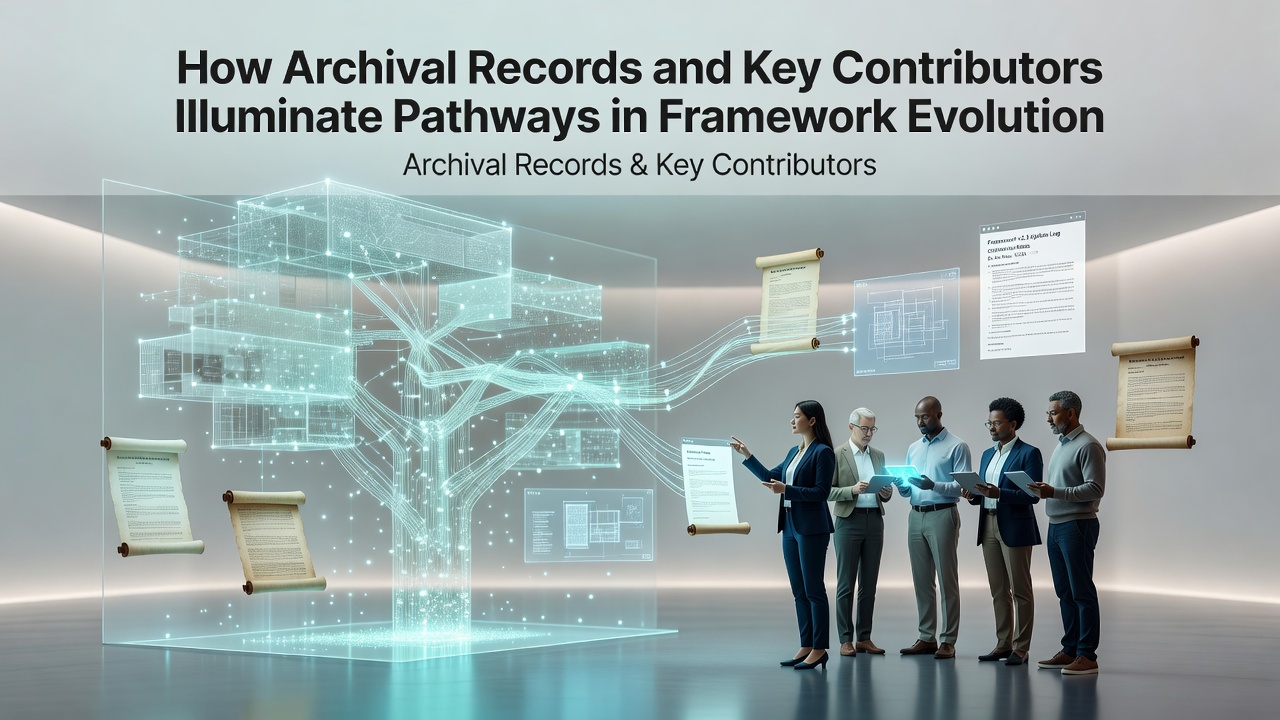
Archival records preserve the sequence of decisions and experiments that shape any evolving framework, and they connect early experiments to later refinements through documented correspondence, meeting minutes, and technical drafts. Researchers examining these materials often trace how initial assumptions gave way to revised models, and they identify turning points where external pressures such as regulatory changes or technological breakthroughs altered the trajectory. Data from preserved collections reveal patterns in iteration cycles, while cross-referenced sources highlight which proposals survived peer scrutiny and which ones were set aside after testing.
Preserved Documentation as a Map of Development
Collections held by academic institutions and standards organizations contain the raw material for reconstructing framework timelines, and they include lab notebooks, internal memos, and prototype specifications that chart incremental adjustments. Analysts who sort these items chronologically observe how terminology stabilized over successive versions, and they note the points at which competing approaches merged into unified structures. Evidence from multiple repositories shows that frameworks rarely follow linear paths, yet the surviving records make it possible to reconstruct the branching routes that were considered and later abandoned.
One study of mid-twentieth-century technical archives demonstrated that minor annotations in margins often signaled the first appearance of concepts that later became central, and similar patterns appear in more recent digital repositories. Government agencies in several regions maintain parallel collections that allow comparison across jurisdictions, and these holdings reveal how regional priorities influenced the adoption of particular design choices. Figures compiled by the National Institute of Standards and Technology indicate that frameworks incorporating feedback from multiple archival sources achieved broader interoperability within five years of release.
Individuals Who Shaped Successive Versions
Key contributors appear throughout the records as authors of pivotal documents, organizers of working groups, and correspondents who circulated draft specifications. Their documented exchanges show how disagreements over core parameters were resolved through iterative testing, and they illustrate the collaborative mechanisms that turned isolated proposals into coherent frameworks. Observers note that contributors frequently drew upon earlier archives to justify modifications, creating a chain of references that later historians can follow.
Case records from collaborative projects reveal that certain individuals maintained long-term involvement across multiple iterations, providing continuity when teams expanded or changed focus. Their personal collections, when donated to public archives, add context that official minutes omit, such as preliminary calculations or rejected alternatives. Researchers who cross-reference these private holdings with institutional files obtain a fuller picture of the decision-making environment at each stage.

Tracing Pathways Through Combined Sources
When archival materials and contributor biographies are examined together, pathways of influence become visible that single-source studies miss. Correspondence logs demonstrate how ideas traveled between research centers, and citation networks extracted from published papers map the spread of specific techniques. Analysts who apply network analysis to these combined datasets identify clusters of activity that correspond to periods of rapid framework advancement.
Records from October 2026 workshops organized by international standards bodies are expected to release additional digitized correspondence that covers the most recent framework updates, and early catalog descriptions suggest these materials will clarify the role of several previously under-documented contributors. European Commission research summaries and Australian academic reports both indicate that frameworks benefit when new archival releases coincide with active contributor interviews, because living memory can supply details that written records leave ambiguous.
Current Applications of Historical Insight
Organizations updating existing frameworks now routinely consult archival collections before proposing changes, and they invite surviving contributors to review draft revisions. This practice reduces duplication of earlier efforts, and it surfaces constraints that were discovered but not fully documented in the original specifications. Data compiled by research institutions show measurable reductions in revision cycles when historical context is integrated at the planning stage.
Training programs for new framework developers include modules on archival navigation, and participants learn to locate primary sources that explain why certain conventions persist. These programs draw upon case examples from multiple regions, illustrating how different regulatory environments shaped similar technical problems. The resulting practitioners arrive equipped to interpret legacy code and documentation without repeating past missteps.
Conclusion
Archival records combined with documented contributions supply the evidence needed to map framework evolution accurately, and they continue to inform ongoing refinements across technical domains. Institutions that maintain accessible collections and encourage contributor participation create conditions for clearer historical understanding. As additional materials become available, including those scheduled for release in October 2026, teh pathways that led to current frameworks will remain traceable for future analysts and developers.